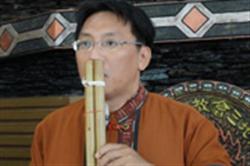
 | Pasteur Gilgiwau plays traditional nose flute (Photo: WCRC/Greenaway) |
By Kristine Greenaway In early April, as a guest of the Presbyterian Church of Taiwan (PCT), I traveled to Paiwan Presbytery in Pingtung County in southern Taiwan. In one-and-a-half days of visits, I caught glimpses into the riches and challenges of the region that is home to several of the country’s Indigenous peoples: wonderful historic Paiwanese motifs painted on ultra-modern houses; people wearing hand-embroidered shirts while driving SUV’s; and a pastor playing a nose flute in a sanctuary featuring a cross made of railway ties rimmed with designer lighting. I was traveling with Hong-Tiong Lyim who was installed as PCT’s General Secretary later in the month. At each meeting, we were greeted warmly and offered insight into the faith and work of PCT. Everywhere we visited, we received generous hospitality including beautiful gifts produced in the area. The spirit of giving extends to the support church members give their church. Each congregation in the presbytery tithes to support the work of the presbytery office. As a result, there is a full-time staff of five. Consider the fact that the World Communion of Reformed Churches (WCRC) has a staff of eight. I can only wish that WCRC’s member churches were as financially supportive as the congregations in Paiwan Presbytery. Eleng Tanu Bak, who at the time of my visit was Presbytery General Secretary, told us of plans for church growth and of campaigns to raise money for scholarships for theology students to study abroad and to support an overseas missionary. Rii, the youth worker, told of ecumenical exchange programmes and of a project for young people to write the Bible by hand as a way of truly becoming familiar with it. Bak has since become Associate General Secretary and moved to Taiwan’s capital city, Taipei, to serve in PCT’s National Assembly offices. Ljenljenman, who heads the women’s programme, told us of the work of women in the area. The women engage in Bible study, fundraising and prayer meetings and have contact with women from India to France to Ethiopia. It is an interesting example of what being connected to global organizations such as WCRC and its partner, the Council for World Mission, can mean for local parishes. The trip through Paiwan county included a stop to see the innovative art work and architecture of Timur Presbyterian Church. A well-known Paiwan artist, Sakuliw, did the design. Walking down the centre aisle of the sanctuary over mosaics depicting biblical stories is like walking through the bible. In Chang Yuan, a new village built to house people displaced by typhoon Morakot in 2009, Lyim and I saw three chapels that are under construction and 106 homes built with money contributed by the Presbyterian Church in Canada, Red Cross, World Vision and PCT. The four year building campaign wraps up in August. It has been a process of rebuilding lives, livelihoods and homes in the wake of the trauma of the typhoon and the massive flooding it provoked. |